Unlike this page, my N2PK VNA project is complete now, it took me three years to get round to finishing it, I now wish I'd done it three years ago. It's such a useful and powerful tool.... more of the build later.

Here are some initial results to show the versatility of this tool.
Reflection mode - a comparison of two 50R terminations. One is a general purpose low power dummy load and the other is an expensive calibration standard. You can clearly see the difference between the two units here.

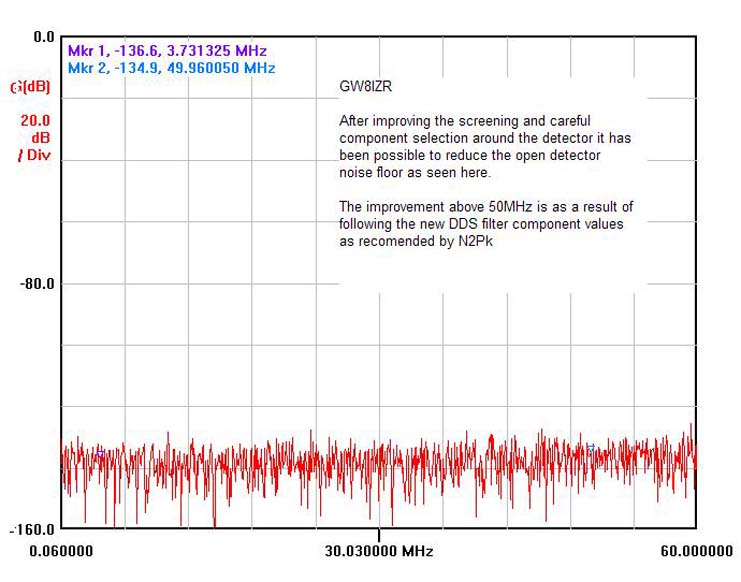
Here is the open detector noise floor. This low level has been quite hard to achieve and I suspect my work is not over yet. There seems to be still some phase shift between the two DDS sources which varies with frequency. I'm still trying to get to the bottom of this. On the other hand this instrument as it stands has 120db of dynamic range from 60Khz to 50MHz!

Update September 08 - after a lot of work here is the final result - open detector noise floor now 15db better circa -135dbm and flat above 50MHz.
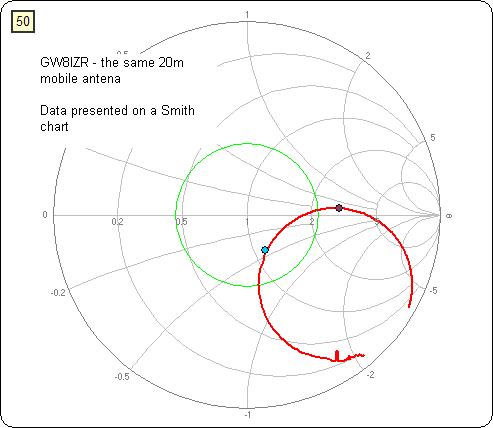
A practical measurement - this is the 20m mobile antenna on my vehicle

And the same data in a different format
And finally for the time being here is some fun with a series tuned circuit demonstrating the usefulness of this tool. A simple series tuned circuit measured in reflection mode. You can clearly see the phase angle of the reactive component change at resonance and the dip in resistance toward zero ohms at the same frequency. The second trace overlay is the same tuned circuit but with an aditional 56R resistor added in series. You can clearly see the phase change and dip in R but this time you can also see the resistance that has been added.

By now you have got to want to build one of these! just Google N2PK or go to N2PK home for more details. Here are some notes about construction.
Is this a project suitable for beginners?
Not really! there is a fantastic resource in the form of a yahoogroup VNA group which is where all the builders and developers are. Your questions will be answered and the support is superb but you will be expected to be able to think for yourself and you will need to be able to build it yourself.
Is there a kit of parts available?
Almost! subscribe to the yahoogroup and there are almost always group buys and kits being put together, this is a hobby not a business so you do have to ferret around for parts. Read the group archives and you will see that everything is available but its not a one stop shop.
What are the component parts of the VNA?
You need an RF board, a power supply some control interface and an enclosure. Throw in a few RF connectors and the list is about complete. Here is an overview of how I put mine together, there are many more examples on the yahoogroup files and photo's section.

Can I solder surface mount components at home?
Yes! but there is a technique to it, you may need to develop your skills a bit but its certainly possible. A bench magnifier or microscope is essential. I use a magnifier to work with and a cheap USB microscope for inspection. Hand tools are a matter of choice but I keep a pair of tweezers, a scalpel, numerous bits of stainless steel antenna whip ground to shape and some fine cutters / pliers in addition to the normal workshop tools. An ESD workbench is essential but you already know that if you are considering this project. Choice of soldering iron is important, I use the Metcal STS system here. This is an RF iron which can cope with soldering N-types and .0025" SMD with the same tool. The bits are expensive but then so are components and my time. A good supply of flux cleaning fluid is useful.
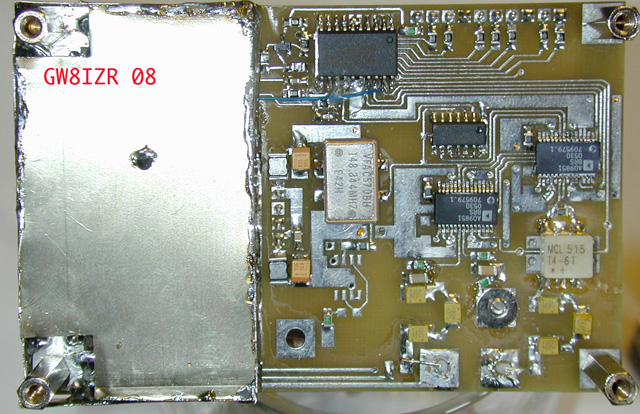
The DDS chips and the ADC's are very small, they are the tricky components to fit but by the time you need to fit them you will have developed a steady hand fitting all of the passive components. The DDS chips make a lot of heat and require a heatsink.

I see the PC control uses a parallel port, I don't have one on my new PC
Thankfully Dave G8KBB has developed a USB converter board and software support is available for all the main control packages. Unfortunately the original N2PK software and utilities are not able to work with USB but there are alternates that work well. All of the plots on this page were made using a combination of MYVNA, VNA4WIN and EXETER. ZPLOTS can be used to manipulate the data. I'm not going to link to these packages because they sometimes move, find them from Paul's N2PK homepage.